Skip to content

Collective Wanderwelle on their collage film The Four Nightmares

Film programmer Tom Ooms (Lab111) in conversation with the collective Wanderwelle, consisting of Alexander Bartels (1993) and Phil van Dulm (1993), about their collage film The Four Nightmares, which premiered during Meet The Archive. Wanderwelle works with sound and image. Their music lies in the twilight zone of ominous ambient and experimental music, which they perform with a large arsenal of electronic, acoustic, and self-made instruments. In a short time, they became known for their vinyl albums and live performances in art galleries, up to the Royal Theater Carré.

By Tom Ooms29 June 2023

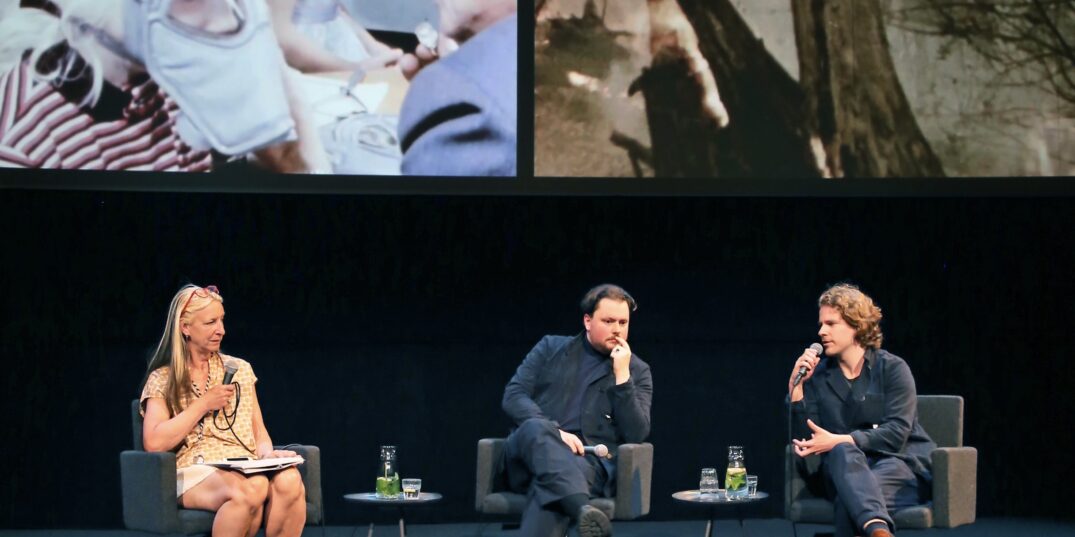
Eye-programmer Anna Abrahams interviews Wanderwelle during Meet The Archive 2023. Photo © Floor Meijers.

How did this collaboration with Eye and the encounter with their collection come about? And what did you want to convey with the used visual material?

We consider Eye Filmmuseum an extension of our homes. A place where we can be found more than once a week to enjoy films, exhibitions and – when the weather permits it – the terrace. On the musical front, we have collaborated with Eye several times before. We provided a short film from the 1920s live with a new soundtrack and participated in the Short Scores programme. We have always been fascinated by how music, and sound in general, can support or completely change the experience of the visual. Around the same time, alongside our albums, we were working on the graphic novel The Centipede (Concertobooks, 2021). Based on the scenario we had written, we developed a detailed thumb-thick storyboard. Illustrator Floor van het Nederend then drew elaborate ink illustrations based on it, and we added colour to his drawings afterwards. It was partly because of this experience that we wanted to make a found footage film. A film that would be completely based on archival material selected by us, which we would then edit and add sound design and music to give it a new, unique narrative of our own.

In all our projects, we draw tremendous inspiration from our shared interests and academic backgrounds (history, art history and medicine). So, legends and tales are important sources of inspiration for us, and for the film, we had the idea of making a contemporary adaptation of the Four Horsemen of the Apocalypse. These horsemen play a major role in the prophetic Bible book The Revelation of John and are seen as the messengers of the approaching Apocalypse, the Day of Judgement. Each horse has a distinct colour and symbolises one of the many facets of total destruction. For instance, the white horse symbolises conquest, the red horse symbolises war, the black horse symbolises famine and the pale yellow horse symbolises Death. The horsemen leave a trail of violence, disease, famine and death in the story, and we sadly saw a depressing parallel between this and our current times.

We pitched this idea at Eye and pretty soon we were able to dive into the collection centre to look for suitable material. Working with archive material is interesting as, unlike conventional film, you have to use existing footage. This sounds like a hurdle at first, but as the images in most cases never exactly match the original idea, we as makers were challenged to let ourselves be inspired by the footage itself and edit it in such a way that it eventually became usable material. So, ultimately, through this making process, we did not create a literal adaptation of the Four Horsemen but rather our own narrative, which was strongly influenced by this ancient prophecy. This resulted in the experimental collage film The Four Nightmares. The work depicts the story of an unnamed man plagued by a series of fever dreams that foretell the end of time. The great crises of our time follow one another like hallucinogenic nightmares from which there is no escape.
With your music, record covers, graphic novel and other creative expressions you often refer to art, philosophy, history and of course film. What are important inspirations for this film and for your identity as brand new filmmakers?

At first, our main source of inspiration was a combination of the biblical book The Revelation of John and various, disastrous present-day events. However, as the creative process evolved, a narrative emerged and we allowed multiple ideas and artistic expressions to inspire and influence us. Time does not run linearly within our work. For instance, we intertwined the climate crisis and its impact on coastal areas with ancient sailors' superstitions and medieval folklore for our album trilogy on US label Important Records. Despite the past being a distant, different land, many parallels and echoes with the present can be discerned among the tangle of endless events. However, we don't avoid the differences with the past either; the places that are abrasive. The cruel(er) way in which animals and people were treated in the past is something we show in our film as well. We constantly try to seek out the space between these juxtaposed timelines, which harbour both reason and superstition.

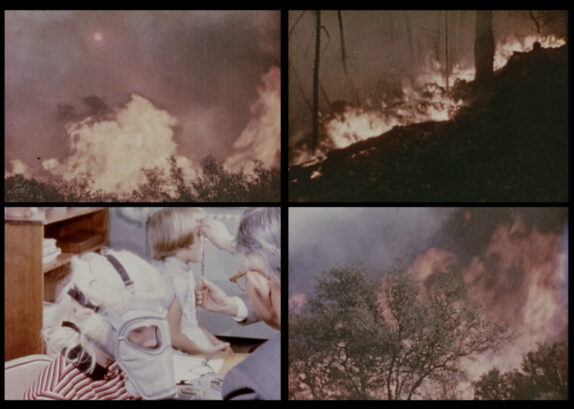
For us, it therefore feels very logical to use archive material to address problematic, contemporary issues. This idea also emerges in our video installation The Summer of '72 (Fire), which was shown prior to The Four Nightmares. In a split-screen format, archive footage of classrooms from the 1970s interlace with footage of forest fires. Slowly, the fire intensifies and the school is engulfed by the flames. In this work, we connect the 1972 Club of Rome report, education and the climate crisis. Think of it as a modern prophecy that has now, half a century later, come true. In this way, the work shows the missed opportunity of how education could have substantially influenced the current state of the climate crisis if the youth had been properly educated at the time.

Wanderwelle, The Summer of ’72 (Fire) (2023), still, HD video installation, colour, sound, courtesy the artists

It is interesting that while making The Four Nightmares, we were influenced much more by conventional films and (assembly techniques in) the arts than by found footage films. Hence, the works of Jan Švankmajer, David Lynch, Luis Buñuel and the Quay brothers, among others, are always haunting our collective subconsciousness. The observant viewer will surely notice the nod to Un Chien Andalou. The work of a number of painters who have been inspired by nightmares over the centuries have also strongly influenced us.

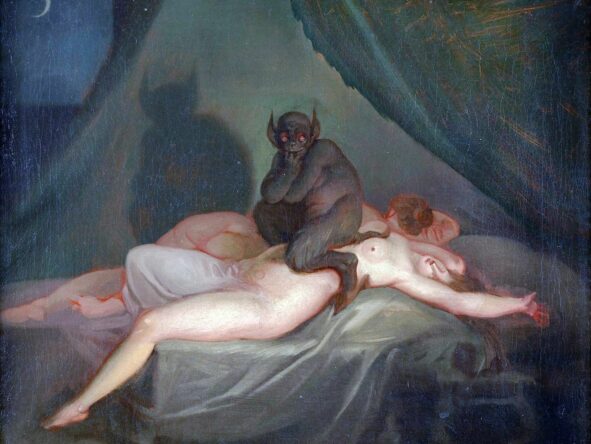
Nicolai Abildgaard, The Nightmare (1800), oil on canvas, (35.3 cm x 41.7 cm), Vestjaellands Art Museum

Swiss artist Henry Fuseli's painting The Nightmare (1781), which shows how an incubus, a male demon who visits women at night and induces nightmares, is perhaps the most famous example of this. Personally, we are bigger fans of the version painted by Nicolai Abildgaard in 1800. That work radiates a very unsettling atmosphere and it is in that spirit that we wanted to make our film.

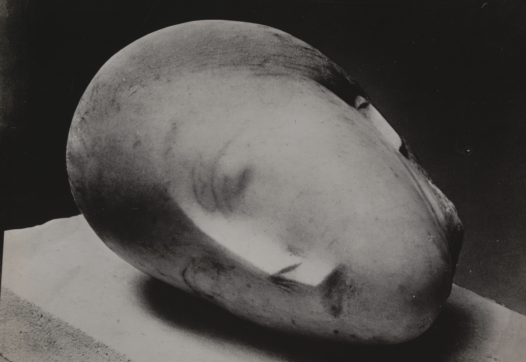
The work of Romanian artist Constantin Brâncuși influenced us in particular because of the serenity and contemplation his sculptures exude. It is an abrasive contrast to the works of Fuseli and Abildgaard. We tried to emphasise that difference at a very important moment in the film; the instant before the man is being whispered his evil dreams. A silence before the storm.

Constantin Brâncuși, Untitled (Sleeping Muse)[c. 1910], gelatin silver print, (17.4 × 23.1 cm), Museum of Modern Art
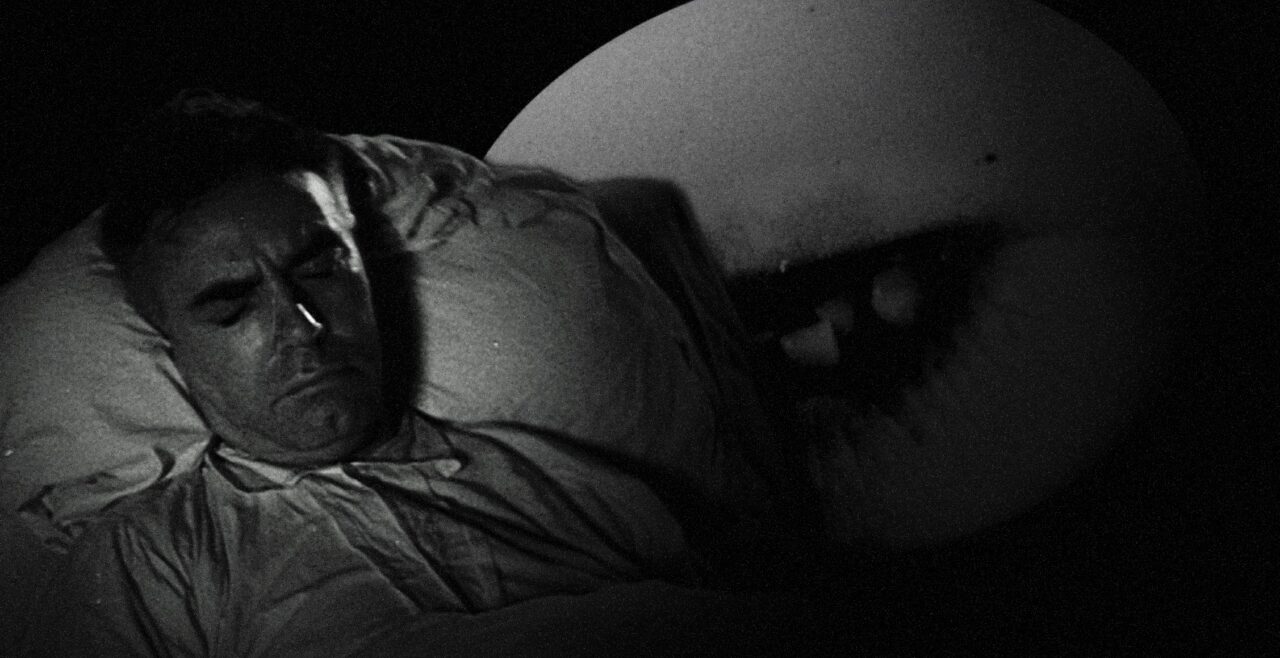
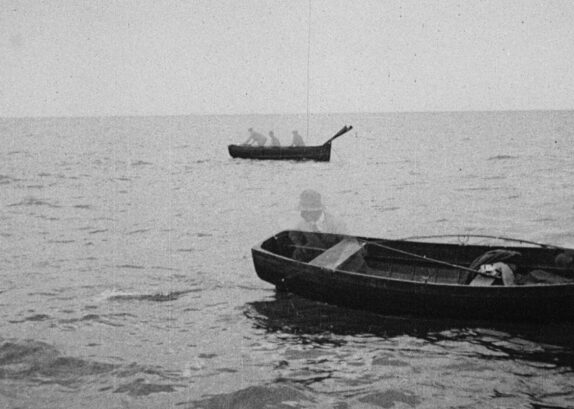
Wanderwelle, The Four Nightmares (2023), still, b&w and colour, sound, courtesy the artists

In terms of editing, American writer William S. Burroughs was inspirational to us. His cut-up technique caused a sensation in the 1950s and 1960s. Burroughs cut up text from existing sources and then reassembled it in a new combination. We are fascinated by this kind of aleatoric method, which, like Dada and the music of John Cage, produces surprising results every time. Sometimes it works, sometimes it doesn't. But when it works, with the right footage it feels like you're in a fever dream, and that was exactly what we were looking for.

How did you go about providing the film with a musical accompaniment? Was the image leading here or did a certain composition sometimes inform the editing? Have certain instruments or techniques been used to reinforce the theme?

The footage was definitely leading. Especially as new ideas often arise during the editing of found footage, it was not very efficient for us to have the definitive music in advance. However, we did already have ideas for certain scenes and used our own music as placeholders during editing. It was interesting -and unexpected- to find that editing in complete silence was definitely not beneficial to the creative process. For the music, we used voice recordings, synthesizers and manipulated violin strings, among others. These elements formed the basis for a composition that at some moments almost harmoniously goes along with the image and at other times clashes with what one sees. In this way, the overall composition raises the question of what is reality and what is not. In terms of sound, the film focuses mainly on the sound design. Apart from the two original jazz fragments, all the collected material was supplied without music or sound. It was a joy to collect all the necessary sounds or to create them ourselves. Sound has the power to totally change the context of the images and during the making process, besides animation, it was one of our biggest tools to get the story off the ground.

For example, the tapping of dog nails on a wooden floor or his panting is hardly noticeable, but when it's missing, you immediately realise something is not right. Sounds that contrast with the image are the most interesting as at such moments you alter the context of the material and make it part of the larger narrative you have in mind. As a result, upon hearing the monkey's strange, almost spectral, wails, the viewer immediately realises that this is not just any tormented animal but something fundamentally different. Something that is not part of the same world as the dog, with its normal sounds, lives in.

Unfortunately, detailed sound design is often lacking in many found footage films. As far as we're concerned, this is a big miss as the right sounds give the viewer – consciously or unconsciously – much more of an impression that they are part of what they are seeing. In the accompanying video installation, we also placed more emphasis on sound design rather than music. For instance, we edited recordings of creaking doors, which referred to both the burning wood and the classrooms, into a distorted soundscape.

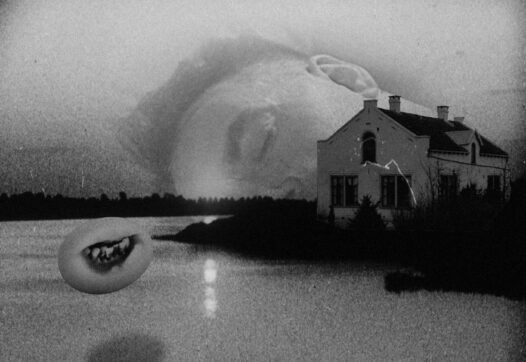
Wanderwelle, The Four Nightmares (2023), still, b&w and colour, sound, courtesy the artists

A leading object in the film is an animated, floating egg, affectionately known as 'The Evil Egg' during the presentation. We leave the interpretation of this egg to the viewer, but the animated aspect was very reminiscent of the work of Virgil Wildrich or the cut-and-paste animations from David Lynch's third season of Twin Peaks. How did you arrive at this animation and what place do you think the film occupies in the found footage genre?

The idea of editing and animating images arose, as we wanted to impose our own narrative on the archive footage more and more. It was like a battle between us and the material. The malleability of the material was so limited in some cases that we had no other choice than to create new images ourselves by fusing different elements together and turning them into moving collages. This allowed us to give the narrative precisely the stylistic shape we had in mind.

Great artists within the genre such as Peter Tscherkassky and Bill Morrison work mainly with the characteristics of the physical medium. They accentuate damages, manipulate the medium with light or cut everything up into an homage to cinema itself. You will never see Tscherkassky making a film outside his darkroom. An extremely intensive, time-consuming way of working that we watch in awe. For us, our own narrative will always be more important than the medium. That way, we can put more of ourselves in the film, and the editing and animation software gives us that possibility as well as the freedom to do so. Because all the footage we selected was delivered digitally, it was possible for us to use this method of filmmaking. So, the result can be extremely different when working in analogue or digital ways. As far as we are concerned, both methods have their own charms and qualities. Both are approaches can be compared to the Dadaist and Surrealist way of assembling. You find objects, in our case archive images, which you then present in a totally new context by editing the source material.

Our method goes a step further by creating totally new images in addition to reassembling the archive footage and then animating these images. Something we want to apply even more in our next film. For instance, we could animate non-existent landscapes or characters that were essential to the story. A key role is given to an assembled, giant goose egg with a mouth full of crooked and battered teeth. The floating egg fulfils the part of the antagonist, whispering the four bad dreams to the bedridden man. In the end, the egg became the recurring theme throughout the frame narrative. This apparently worked so well that the egg managed to break free and emerged several nights after the screening in the nightmare of a friend of ours...

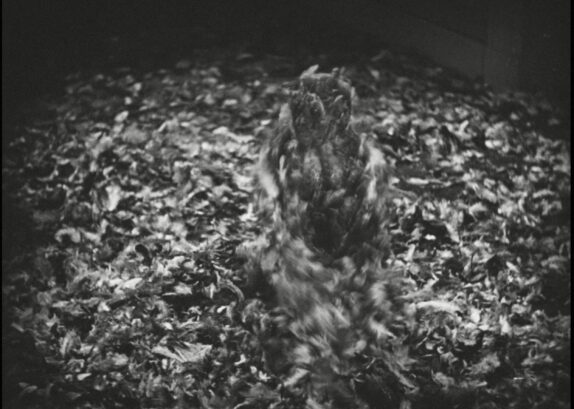
Wanderwelle, The Four Nightmares (2023), still, b&w and colour, sound, courtesy the artists

The Internet, with its memes, TikTok, and the like, has given a new twist to visual language and the way we deal with archival images. How do you see the future of the found footage genre? And what role do you think AI, for example, could play in this?

The found footage genre has been incredibly niche from the beginning and we see no reason why that will change despite the ever-expanding world of social media. And we don't mind at all. It really is a genre for the connoisseur and therein lies much of its strength and charm as far as it concerns us. Of course, social media do play a connecting role in niche areas and we notice online that passionate individuals or small clusters of admirers of the genre find each other. In addition, in recent years we have seen more and more films based on found footage appear on the big screen. Think, for instance, of the wonderful Three Minutes - A Lenghtening, the visual monument by Bianca Stigter, or more recently, Sergei Loznitsa's The Natural History of Destruction. We are looking brightly at the future of found footage films.

We have always been very interested in AI and have been following developments in the creative field closely for quite a few years. It is incredible to see how fast AI has developed over the past year. With one simple prompt as input, it is already possible to produce a true-to-life 'photograph'. Motion imagery is the next challenge. The era when one could still somewhat trust video is definitely coming to an end within a few years. AI combined with mass consumption and the ever-increasing commercialisation of the film industry is also of great concern. Hollywood has long ceased to be Hollywood with all its franchises, reboots, remakes, sequels and it will be a matter of time before a large part of the screenwriters, special effects people, cameramen and even actors will be replaced by AI programmes. Indeed, the lion's share of consumers will not care whether their entertainment is created by human hands or by a computer.

This is another example of the power of the found footage genre. The beauty of niche art lies in its imperturbability in the face of trends. Quality over capital. But even within this genre, AI can of course play an important role as a tool. As with any technology, it obviously depends on who is using it. We used AI for The Four Nightmares as well. In a number of sequences, we wanted some characters to slowly dissolve. From person to phantom and from phantom to shadow. In these places, the AI filled in the initially invisible background for us. We also see that AI manages to restore old film material in wondrous ways.

Wanderwelle, The Four Nightmares (2023), still, b&w and colour, sound, courtesy the artists

But again, all in moderation. It is very important to guard against too far-reaching restoration, as this risks losing the authentic elements, some of which ultimately form the core. It is the imperfections of old film material that add so much atmosphere to the images. Apart from the images themselves, these artefacts also make you realise that you are watching a time long gone. A time you want to sink into or stay far away from. We are convinced that the end of this century will be unrecognisable in almost every field compared to the present, and AI will play a gigantic role in it. Both benevolently and maliciously. That may sound exaggerated, but let's not forget that the time span between the development of the airplane and the moon landing was less than 70 years. The last few centuries have been churning rapids where we, as humanity, are increasingly encountering whirlpools and waterfalls. And yet, despite all of this, we emerge every time.