
“Two birds in one night…” 24 March 2002, the evening the institution we know as the Oscars could no longer stretch its shattered credibility any further and was forced to give Denzel Washington an Oscar. Denzel, the cinematic titan. The absolute best who shines in every film, he was also fabulous in his role as Detective Alonzo Harris. Nevertheless, it is only in the context of white comfort and the imagination this hijacks, that we can explain why he won the Oscar for Best Male Actor not for his roles as al-Hajj Malik al-Shabazz, better known as Malcolm X, or Rubin ‘The Hurricane’ Carter, but specifically for Training Day.
Even before he played the character who called Ossie Davis “our own Black shining prince”, Denzel played Steve Biko. He studied the anti-apartheid activist to such an extent that he even managed to get his eyes, that are markedly different to those of the legendary South African icon, to adopt a typically Biko gaze.
Deep footsteps
Simone Zeefuik pays tribute to Sidney Poitier and Denzel Washington and hopes that more Black actors will fill each other's footsteps. The bond between Poitier and Washington is one of the best examples of the value and necessity of Black, intergenerational mentorship.
By Simone Zeefuik12 August 2022
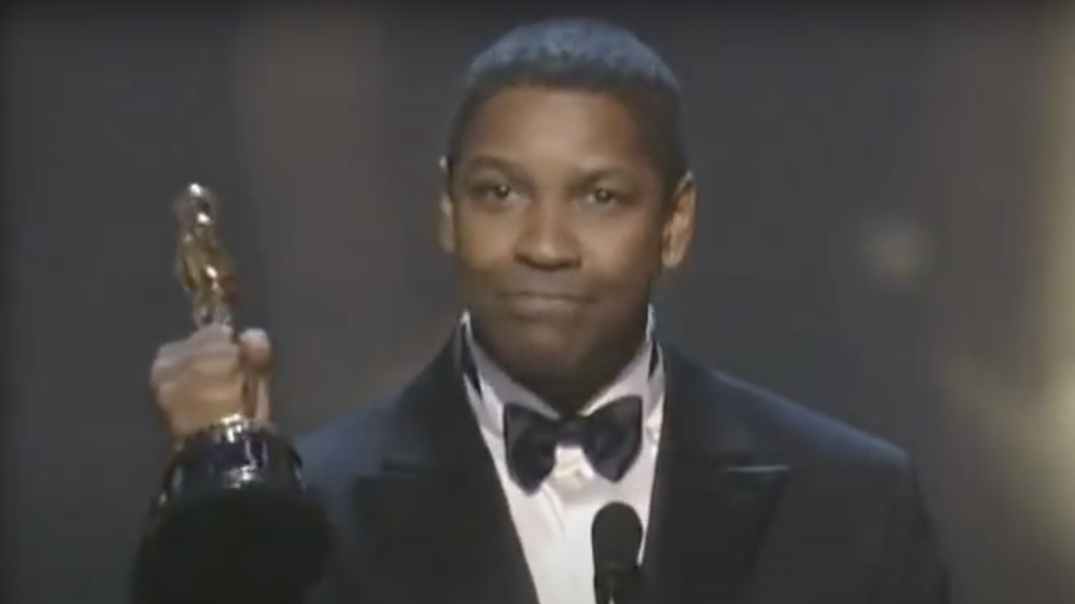
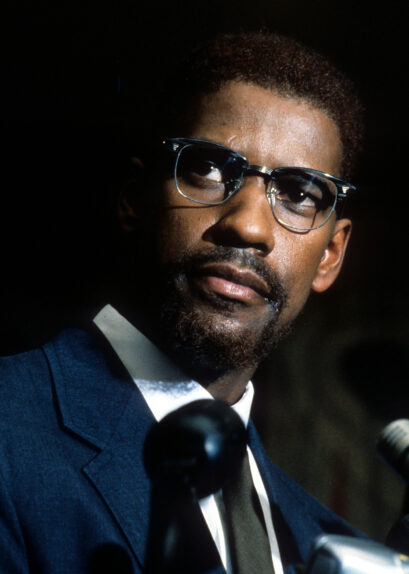
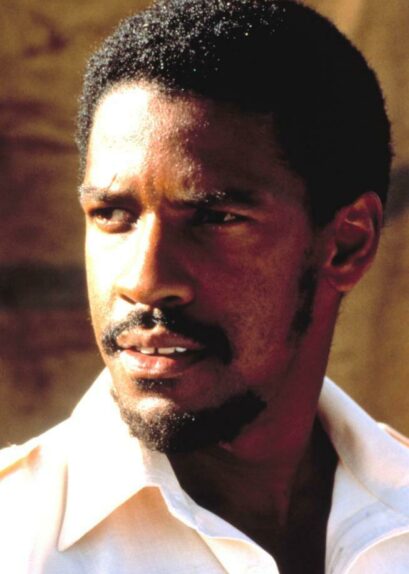
When it comes to Hollywood cinema, there truly isn’t another male actor in the generations surrounding Denzel that has the range he exhibits both on the big screen and on stage. When referring to generations I mean the decades-deep block with Michael K. Williams on one end and Denzel’s great idol on the other. “40 years I been chasing Sidney. They finally give it to me, what they do… they give it to him the same night.” There’s something indescribably delicious about the way Poitier’s body shakes as his wonderful guffaw sounds in response to these words and subsequently, on the balcony with his oeuvre prize in hand, stands for the young man who so clearly, openly loves and adores him. Then Denzel salutes Poitier with his Oscar and says he will always follow in his footsteps.
40 years I been chasing Sidney. They finally give it to me, what they do… they give it to him the same night.
Denzel Washington
And he has done. Sometimes figuratively, as a torchbearer of Poitier's activism, the corresponding demands they set for scripts or stage directions, and as an actor who played in both mainstream films and major theater plays. Sometimes literally as in the case of Lorraine Hansberry’s A Raisin in the Sun in which both Washington and Poitier played the role of Walter Lee Younger, albeit in two different centuries. Washington moved with love from Poitier’s footsteps. “There’s nothing I would rather do, sir… nothing I would rather do.” That proud look of Poitier sitting back down to make room in the momentum for the actor he's mentoring? The way he breathes out and allows an “Aah” to escape from the depths of his chest? That is the true prize.
The slap
As a remix of Paul D’s famous final words in Toni Morrison’s Beloved I would like to plainly state a single truth: we are our own best thing. The connection between Poitier and Washington is one of the most visible examples of the value and necessity of Black intergenerational mentoring. Washington has Potier’s examples to thank for a major part of his imagination. These examples can partly be found in films Poitier played in, but to truly understand their impact and what was at stake, people who haven’t done so already should really immerse themselves in this Bahaman icon. The more generations between us and the films’ release dates, the smaller the milestones seem. Take, for instance, In The Heat Of The Night, the 1967 film known for the ‘the slap heard around the world’, the moment Sidney Poitier, playing detective Virgil Tibbs, slaps a white racist’s face. This was the first time this was depicted in a Hollywood film, which made it undeniably spectacular.
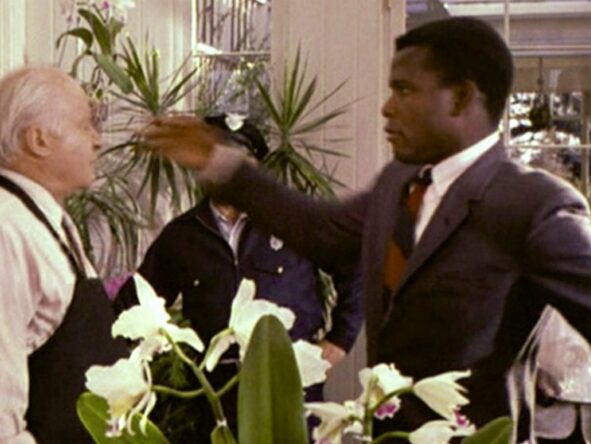
Isabelle Britto (The Black Archives) wrote an article about that famous slap heard around the world Sidney Poitier threw in In The Heat Of The Night.
However, the slap gains significance when you find out that Poitier and his ‘brother’ Harry Belafonte donated many thousands of dollars to the SNCC, the student-founded organisation that played a crucial role in the American civil rights movement of the 1960s. The slap gains volume when you read in Harry Belafonte’s memoirs and Poitier’s autobiography that although Poitier was physically present at a number of protests that the Ku Klux Klan threatened he absolutely didn’t want to be there. That he was forced to hide in the trunk of a car from white terrorists. And that he did not return to the terror-defined south of the US for quite some time, but always continued to provide substantial financial contributions to a struggle in which high bail costs, travel and material costs were a daily concern.
Impact beyond the films
Furthermore, there have been many, many moments that Poitier spoke about being Black and spoke out against anti-Black racism in the USA on talk shows, at round tables and other media opportunities. He introduced a directness which people would later recognise in the way Washington spoke about what he considered the responsibility, duty and joy involved in depicting Black characters or icons in a manner that suits both our reality and our imagination. I would be willing to invest plenty of programme budget to have filmmaker Bibi Fadlalla create a number of brief compilations in which we, see Washington and Poitier converse with one another on the basis of their interviews and acceptance speeches in the style of the visual offerings Lynnée Denise made for bell hooks and Toni Morrison.
This is where the lessons are, the basis for reformulating the questions, but definitely also the requirements. Denzel’s impact also extends far beyond his films you see. He donates to established Black universities in the USA, creates study groups with young Black actors he mentors and he is a theatre aficionado who does his utmost to ensure that the works of deceased, Afro-American playwrights are not forgotten.
Screening Fences and/or Ma Rainey’s Black Bottom, both based on the eponymous plays by August Wilson, automatically guarantees an evening of beautiful cinema. However, what makes these films extra special is the fact that the representatives of Wilson, who died in 2005, have full confidence in Denzel and he is set to also film Wilson’s other eight plays. One will be released every year in conjunction with HBO. It is in this dedication to our stories which, as Washington explained in an interview about Fences, are much harder to tell properly by someone who is not intimately familiar with Black culture, echoes Poitier’s mentoring and his advice on the importance of investing in artistic representation.
Apples of the eye
All that remains is the cliched question: “Who is our Denzel Washington here in the Netherlands?” The answers I’ve heard so far seem to intimate that we primarily think the persons mentioned are great actors who we’d be happy to see enjoy careers like Denzel’s. When we answer, we are talking about who would be technically capable. From Emmanuel Ohene Boafo, José Montoya, Werner Kolf and Adison dos Reis to Kenneth Herdigein, from Akwasi and Yannick Jozefzoon to Felix Burleson… we have excellent actors I am 100 percent certain could be the answer to the above question. But … to be honest, how are we supposed to know with the current range of Dutch films and plays? What could we use to assess this? Name five Dutch films these actors could have shown their Denzel qualities in … and, let’s be honest about the climate in this cinematic landscape and why they weren’t in them. How often would the Dutch Denzel be employed in the Netherlands? Who here writes scripts that are so timeless and so us, that two of our top actors could play the same role 50 years apart as Washington and Poitier did in A Raisin In The Sun?
I’ll always be following in your footsteps. There’s nothing I would rather do, sir… nothing I would rather do.
Denzel Washington to Sidney Poitier
More than any prize I wish my acting ‘brothers’ in the Netherlands loving mentoring, fabulous scripts, sublime directors, much better casting considerations and, above all, a great deal of enjoyment. Enjoyment they can be proud of that results in work they can confidently leave as a legacy. I would like to wish them deep footsteps, on the basis of which the apple of their eye will, some 40 years later, look up to them and who, as Washington promised to Poitier, will say: “I’ll always be following in your footsteps. There’s nothing I would rather do, sir… nothing I would rather do”.