
She bought her first handycam when she was 12. “I’d mess about with the editing programme Let’s Edit 2 in my attic. It was Windows software, really basic. My parents often had to call from downstairs: ‘Mieneke, are you coming down for dinner?’ I’d answer: ‘No, I’m still busy!’”
Encouraged by her father she attended the Film Academy open day and was accepted to the programme. “I was one of the four youngest in my year, and had a lot of catching up to do. Many had already completed a study programme, had family in the field and knew their cinema classics. I did a lot of learning during the first three years.”
After graduating, Mieneke dreamt of having her own studio. A place where images and sounds, editing and sound design came together. She managed to create such a place with her classmate Vincent Sinceretti (sound design). They employed a trainee and made the feature film Prins, which won Mieneke a Golden Calf for editing. Countless projects followed. She assisted on 12 Years a Slave, worked on De Oost, the documentary Mijn seks is stuk and the series Moonriders. She has recently finished working on the feature films Met mes and Pink Moon.
Female Gaze: Mieneke Kramer
The blonde bombshell, the femme fatale, sirens of the silver screen. For 125 years, we have seen women on the cinema screen, but they were seldom in control behind the scenes. Luckily, things are finally changing. In this series of interviews, inspiring female filmmakers talk about their own work on the basis of film excerpts from other women’s films. During this, the eighth interview, Mieneke Kramer will discuss her field, editing, and selected Druk (Another Round) by Thomas Vinterberg, edited by Anne Østerud, to do so with.
By Gina Miroula30 May 2022
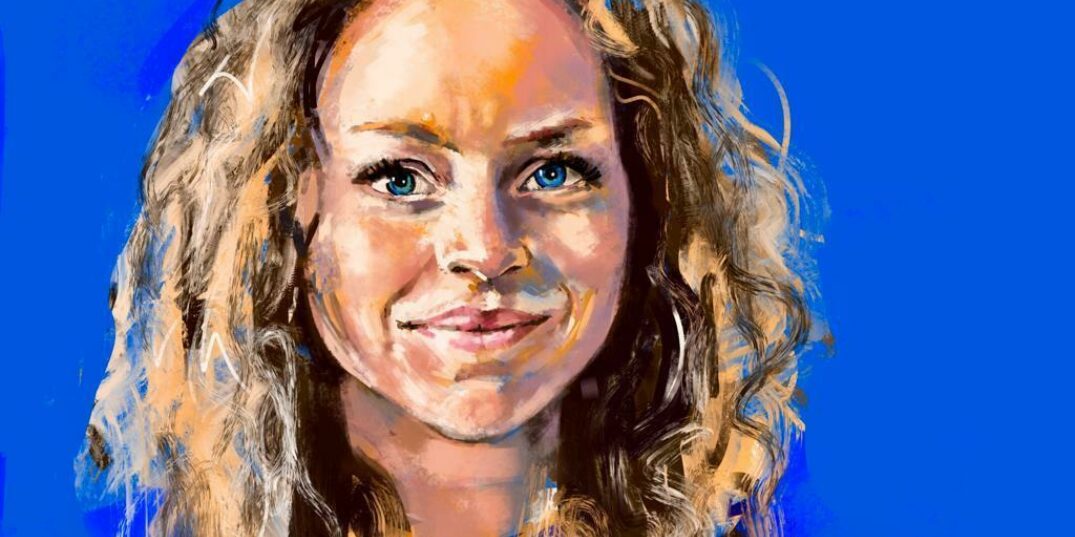
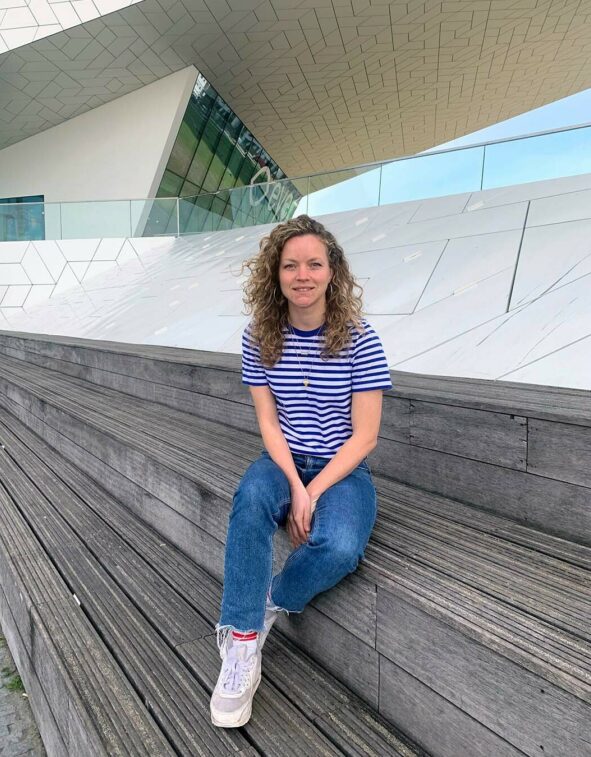
“I often compare editing to my mood on the football pitch,” explains Mieneke Kramer, sat on the steps leading to Eye. “As soon as the referee blows the whistle or I get passed the ball, I forget all my worries.”
You picked Druk (Another Round). What appeals to you in this film?
“It was made in a self-possessed, controlled manner. After watching it in the cinema, I wondered how things had been in the editing suite between editor Anne Østerud and director Thomas Vinterberg. This with a major project such as 12 Years a Slave in mind. At the same time, I know that it doesn’t matter how major the film is. Being together in the editing suite is always an intimate process: it’s you and the director. Which insecurities, choices, fun and tensions would they have experienced? The challenge for editors is to remain responsible for months. To maintain an overview of the characters and control of all the developments and emotional moments.”
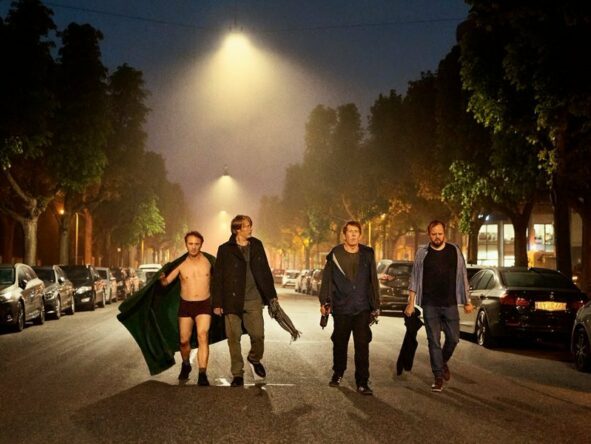
Druk’s narrative centres on Martin (Mads Mikkelsen) a reasonably unhappy teacher. Together with three colleagues, he experiments with trying to keep his blood alcohol high all the time.
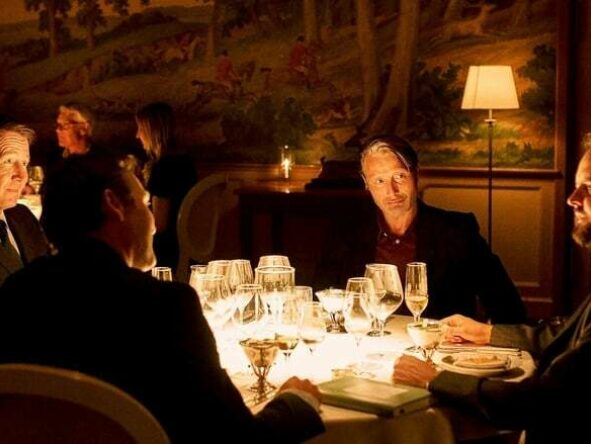
“Brief opening scenes help introduce and set up the lead, the situation and the status quo. The information acquired during the first 15 minutes allows you to speed things up. The key scene that follows features a large group dining.”
Mieneke explains that, as the scene progresses, the music gradually becomes more conspicuous. It also clarifies that alcohol plays a major role in society. “Østerud zooms in on the glasses and the subject of conversation.”
“In Druk choices were made and editing was controlled. Often canted towards reactions, not action. Editing dialogue demands guts. Often, the initial impulse is to edit for the person talking first, then to cut to the person responding. That often works because things have to be explained in a business-like manner. Cutting at the ‘moment suprême’, where the response arrives and the receiver starts to feel, is very exciting.”
What fascinates you about the job of editor in the film industry?
“I create something from nothing, I like approaching every project as something new and fresh. My job consists of two components: I watch the material and try to listen to what it is telling me. Not just the images and sounds, but what those two do together. First I have to feel it, only then do I analyse it. I then think: what do I want it to say? What can I do with it so I can translate this for the viewers? How can I tell a new story and what should the latter be? This helps me constantly stay open: am I still feeling it?"
Mieneke calls scenes that stand on their own, that truly move her: ‘priceless’. “Sometimes I don’t need to do anything to them: no additional music, no editing, it’s all in the take itself. I enjoy being captivated by the acting in fiction films. For documentaries the material can also have something to say about me, otherwise it doesn’t move me.”
How do you start editing a feature film?
“I first read the script; this takes place simultaneously at multiple departments. This is followed by a script meeting (what to tell) and a style meeting (how you tell the story). We subsequently immerse ourselves in the music and sound. We perform technical tests: how will shots be taken during the shoot? How will this be supplied to me in my editing software? You want to be properly prepared. No technical issues should develop as the deadlines become increasingly stringent. The director then shoots. I sometimes ask for photographs to get an idea of the atmosphere, but generally try to stay out of things at that point in time.”
Mieneke prefers starting a new project independently. That way there is room for her own ideas and she isn’t ‘contaminated’ by what she wants or had hoped things would be. “After my initial version I have the director watch it with fresh eyes. That makes some directors nervous, particularly if this is our first time working together. The second version is often seen at a viewing which also involves third parties. Finally, there are a series of test screenings: substantively with your own crew, then focusing on sound; I also watch those.
Can we delve a little deeper into the feature films you have edited recently?
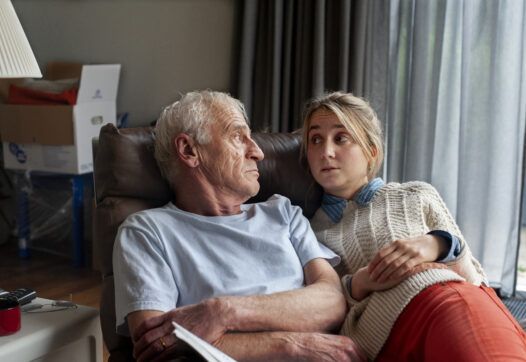
“Met mes (Sam de Jong, 2022) about a game show host who is robbed of her new video camera, is mainly plot-oriented. Pink Moon (Floor van der Meulen, 2022) in which a young woman deals with the news that her 74-year old father wants to end his life, is a more cinematic project. Both films were excellent cooperations. You sort of enter into a love triangle involving you, the director and the film.”
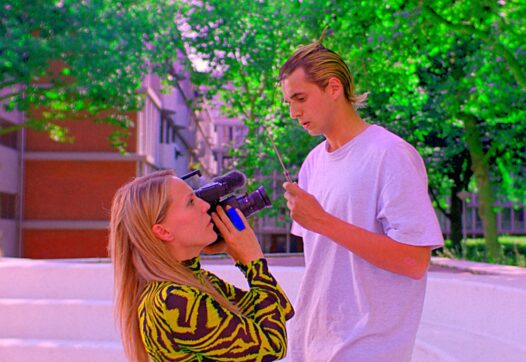
“Sam and I make good sparring partners. He thinks fast, fires ten ideas at me, from which I select two. Sometimes we go outside for a while to allow things to settle after which we get to work. During the edit, we often had to stop ourselves milking the jokes, cutting away at just the right moment. The joke needs time not to become uncomfortable, but should strike at a point where you aren’t done with the shot yet. Crew members once told me: ‘We thought we were pushing things, but what you did with the footage, is out there’.”
When it comes to Pink Moon, one scene in particular stood out to Mieneke, a dining scene some 20 minutes into the film. “It was quite a difficult scene. There are four characters and a single, a double and a total shot. I really wanted to nail it, primarily used intuition for the edit and spent two whole days on it. After four months of work, the scene could still hold its own. It’s right from start to finish and it convinced Floor and I that we didn’t need to do anything further to it.”
Where do you derive pleasure from during editing and when do you experience complications?
“I enjoy getting into a flow state during my work. It feels like being trapped there: my hands working faster than my head, scarcely able to keep up with my thoughts. Like, for instance: ok, I can reverse this shot. I can add music here. Now I need to mute the sound. No, again. No, the other way around. I am briefly disassociated from reality.”
Mieneke finds it hard when a scene has failed and she has to build something from what it isn’t. “This happens a lot, because things aren’t always done justice on set. My edit then hides something from me: a certain way of storytelling.”
At which point in the creation process are you brought in?
“Some projects I am there from the beginning because they start conceptually, more on the basis of an idea. Or I am asked to respond to a finished script. I enjoy co-reading scripts, but sometimes I can no longer make out the changes and lose track of things. I also love first enjoying the footage and only then deciding what I think of it.”
Sometimes Mieneke is asked to assess a version the director has worked on already. “The advantage to getting involved early is that it already includes sound, sound design and music. This allows me to come up with what I think might be needed in post-production: which scenes, structures and sequences work. I enjoy discussing matters with the director.”
How do you enjoy working with the director?
“That differs per person. A while ago, I was working on a project where the director was present for whole days.” We often first spent two hours talking about the film, after which I put her behind the controls and exported QuickTime files to her laptop. Almost everyone can use Premiere a bit.” Nevertheless, Mieneke prefers to carry the process’ load herself. “I look at what happens if I am cheeky and, for instance, remove a scene. Without the director I feel a lot more free.”
One of Mieneke’s favourite jobs is watching raw footage. “I have a lot of patience, love being dragged along. Take after take, rush after rush with a cup of coffee. At a certain point I’ll notice: this moves me, and then I’ll secretly start editing a bit. That no one can take from me.”
Which other project can we expect from you this year?
“At the moment, I am busy with journalist and author Clarice Gargard’s documentary about the resistance to and struggle against racism and discrimination from a black perspective. An exceptional project, particularly for me as a white person. The theme means I am undergoing a period of strong personal growth.”
At the end of 2022, I’ll start on a film about euthanasia with director Laura Hermanides. The story is told from the perspective of parents forced to lovingly let their child go. Myrthe Mosterman did the camerawork. “In 2012, Laura, Myrthe and I graduated simultaneously. Now, some ten years later, we are back together in the editing suite.”
Mieneke laughs, stares across the IJ River. “Do you know what the thing is with my profession? I keep being amazed. That never seems to end.”