
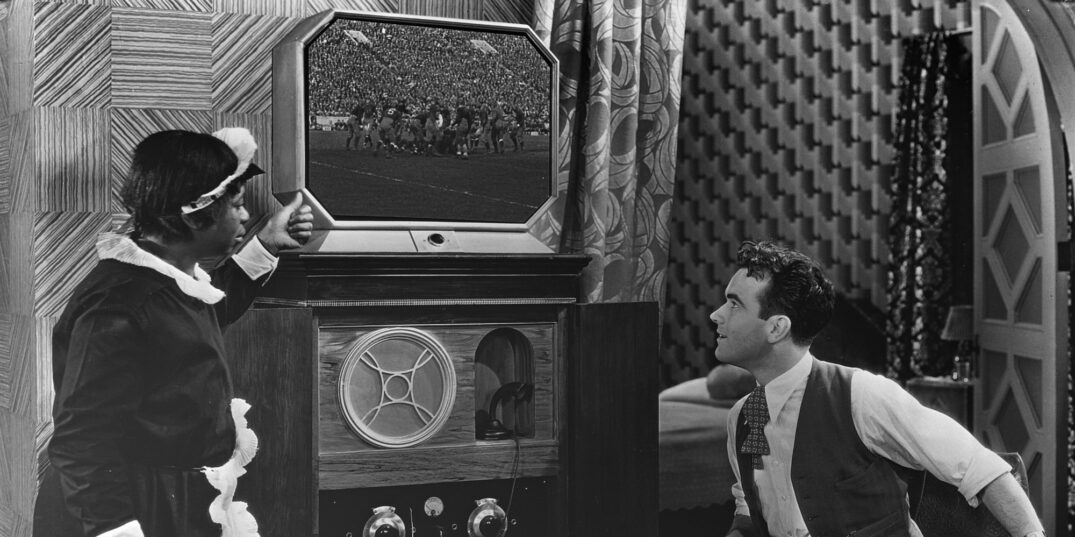
From experimental phase to the central place in the living room
Television found itself in an experimental phase in the 1930s. In the southern Netherlands, a number of amateurs were working on trial broadcasts, and during the 1936 Berlin Olympic Games there were live broadcasts shown in Berlin and Hamburg. These couldn’t be viewed at home, however: people gathered together in Fernsehstuben (television cafés) to watch the broadcasts. The medium developed quickly, though, and after WWII, it was unstoppable. In the Netherlands, the Nederlandse Televisie Stichting (NTS) started its broadcasts in Bussum on 2 October 1951.
Before that, Philips had already experimented with broadcasts for alimited number of viewers. At the end of the 1960s, 80% of all households in the Netherlands had a television and the medium played an important role in the daily life of the Dutch, in both the areas of news services as well as leisure time activities. Just as 60 years before when the emergence of cinema had turned the entertainment industry on its head, television’s arrival changed the Dutch daily pattern of life. The television received a central place in the living room.
